Every industry has its mythology. In software development, the most persistent one is the 10x developer. The idea that certain individuals produce ten times the output of an average engineer. That somewhere out there is a person who, given the same problem and the same tools, simply delivers an order of magnitude more than everyone else. I have been in this industry for over thirty years. I have hired hundreds of engineers. I have worked alongside many extraordinary ones. And I want to make an argument that most people are not yet ready to hear: the 10x developer, as a concept and as a hiring strategy, is over.
Was the myth ever real?
To be fair, there was something to it. The original research goes back to a 1968 study by Sackman, Erikson and Grant that found dramatic variance in programming performance across individuals. Later studies confirmed that top performers could indeed outpace average ones by significant multiples on certain tasks. The variance was real. It came from a combination of deep domain knowledge, fast pattern recognition, intimate familiarity with the codebase, and the kind of instinct that only accumulates over years of hard-won experience.
But the myth also generated consequences that were never healthy. Star developer worship. Knowledge hoarding as job security. Teams with a bus factor of one. Engineering cultures where a handful of individuals became irreplaceable and knew it, and occasionally leveraged that position in ways that were damaging to everyone around them. I have seen this pattern destroy more than one team. The 10x developer was real, but the culture built around chasing that individual was often toxic.

What AI actually does to the productivity distribution
When I look at data from teams that have genuinely adopted AI coding tools – not as a toy, not as a demo, but as a core part of their daily workflow – the productivity distribution changes in a way that is structurally important. The bottom of the distribution rises significantly. Developers who previously struggled with boilerplate, with unfamiliar frameworks, with the cognitive overhead of context switching, now have a capable assistant closing those gaps in real time.
The top of the distribution also rises, but proportionally less. The senior developer who already moved fast moves faster. But the gap between the senior and the junior – the gap that the 10x myth was built on – narrows considerably. A developer with two years of experience, working with a well-configured AI coding environment and a clear specification, is producing work today that three years ago would have required five years of experience to produce. I have observed this directly, and the numbers are not subtle.
This is the democratization of execution. And it is happening faster than most organizations have internalized.
What still differentiates? The things AI cannot compress.
I want to be precise here, because the argument is sometimes misread as “all developers are now equal.” That is not what I am saying. What I am saying is that the dimensions that previously drove the 10x differential – typing speed, syntax recall, knowledge of obscure APIs, ability to hold large amounts of code in working memory – are being compressed by AI. Those were always somewhat accidental measures of value anyway.
What remains genuinely scarce, and what AI does not currently compress, is judgment. The ability to recognize that the technically correct solution is wrong for this business at this moment. Domain knowledge deep enough to spot when the AI-generated code is plausible but wrong in a way that will only manifest six months later under production conditions. System thinking that understands how a change in one component propagates to parts of the architecture that are not immediately visible. The ability to write a specification that is precise enough to drive correct AI output on the first attempt rather than the fifth.
These are the dimensions that matter now. They are also, interestingly, dimensions that were always present in the best senior developers but were often obscured by the noise of raw execution speed.
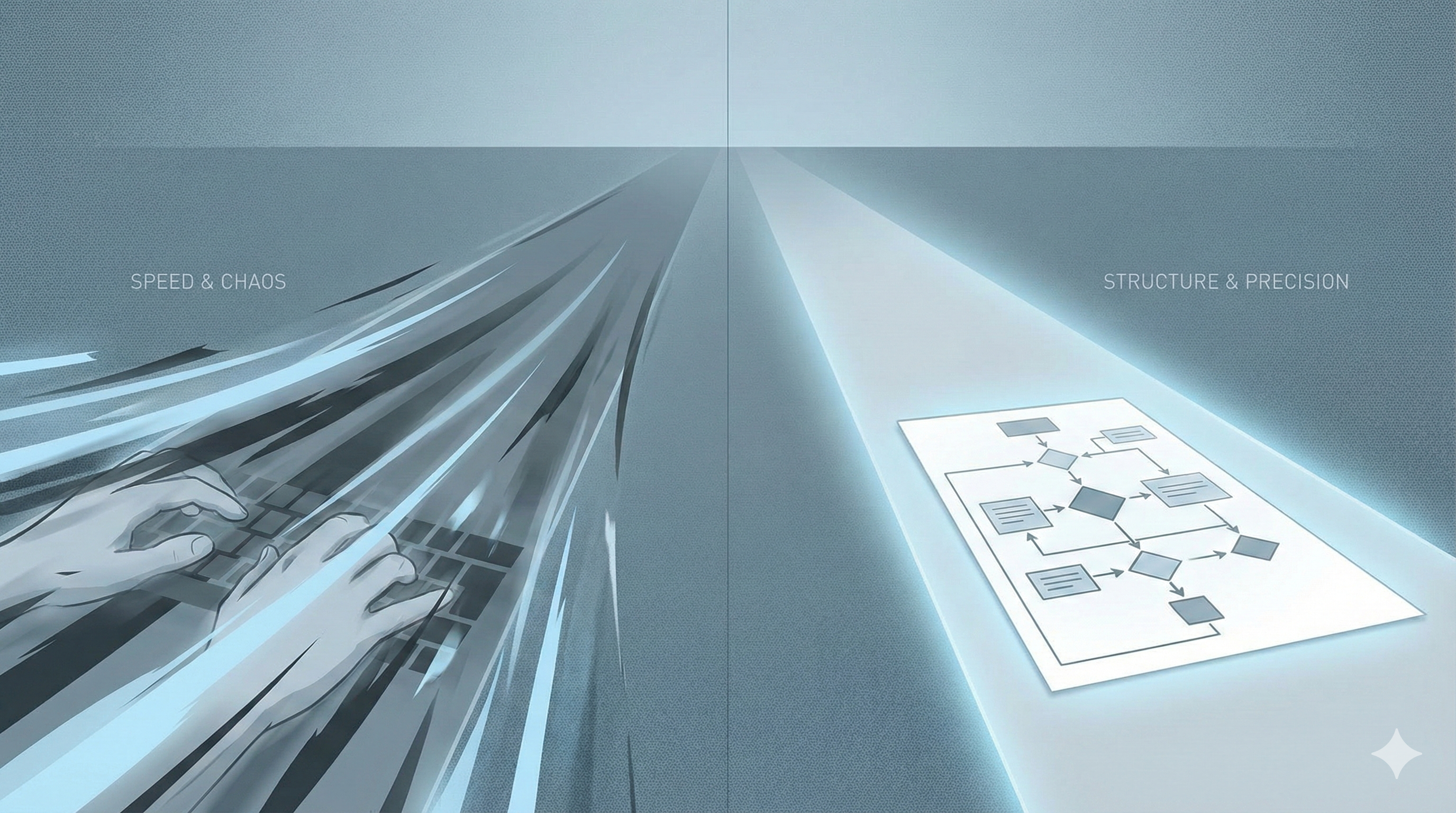
Speed of typing versus clarity of thinking. The second is now the bottleneck
So what does this mean for hiring?
It means the interview process most companies still run is measuring the wrong things. Whiteboard coding under time pressure tests a form of performance that is becoming commoditized. LeetCode exercises optimize for pattern recall that AI can now provide on demand. These processes were always a proxy for what we actually wanted – problem solving ability, communication clarity, system intuition. They were proxies because we had no better measurement. We should replace the proxy, not defend it out of habit.
What I would measure instead: How does this candidate think through an ambiguous problem? Can they write a precise specification from an imprecise requirement? How do they evaluate AI-generated output – do they review it thoughtfully, or do they accept it uncritically? How deep is their domain knowledge in the areas that matter for your product? How do they communicate technical decisions to non-technical stakeholders?
These questions do not fit well into a two-hour coding interview. But they predict performance in an AI-assisted development world far better than any algorithm challenge.
And compensation? And team design?
Compensation models built around the 10x mythology created enormous salary variance in engineering. Some of that variance reflected genuine scarcity of specific knowledge. Much of it reflected the leverage that star performers held in organizations that had allowed single-point dependencies to develop. As AI redistributes execution capacity, the leverage shifts. The knowledge hoarder loses power. The system thinker and domain expert gain it.
For team design, the implications are significant. The argument for large engineering headcounts was always partly about raw implementation capacity. If AI increases per-developer output substantially, the optimal team size for a given amount of work changes. But the answer is not simply to run the same team smaller. It is to run a different kind of team. Fewer people doing pure implementation. More people doing specification, review, domain modeling, and AI orchestration. The roles look different. The skills required are different. The management model is different.
Organizations that reduce headcount as their only response to AI productivity gains will discover they have also reduced the judgment capacity they need to direct the AI effectively. The teams that will win are those that redesign around the new bottleneck, which is not implementation anymore.
The end of a mythology, and what replaces it
Mythologies exist for a reason. The 10x developer myth gave organizations a simple mental model for why some teams were dramatically more productive than others. It gave individual developers an aspiration and a career ladder. It gave the industry a way to justify enormous compensation variance. All of these are real needs, and they do not disappear when the myth dissolves.
What replaces it, I think, is something more honest and in some ways more interesting. The most valuable developer in the next five years is not the fastest coder. It is the clearest thinker who also knows how to direct machines. That is a combination of human skills – domain knowledge, communication, judgment, systems thinking – with a new technical competency: the ability to work effectively with AI as a collaborator rather than a tool.
That developer exists in every organization today, often not in the role you would expect. Sometimes it is a domain expert who never wrote much code but now, with AI assistance, is producing remarkably precise and useful software. Sometimes it is the thoughtful mid-level engineer who was always slower than the star performers but whose output had fewer bugs and required less rework. These people are about to become significantly more valuable, and the organizations that recognize this early will build better teams for the next decade.
The 10x developer had a good run. What comes next is more interesting, and more human.
 ctoblog