Over the last three years, something fundamental has shifted beneath the surface of enterprise technology. It did not arrive with a press release or a migration deadline. It came through the daily work of developers, platform engineers, and IT specialists who started to notice that their tools had become collaborators. After thirty-five years in this industry, from mainframes through client-server, from virtualization through cloud-native, I can say with some confidence: this shift is different. Not because the technology is louder, but because it is quieter and deeper than anything before.
From Writing Code to Owning the Lifecycle
For decades, the developer’s identity was built around writing code. Good code. Clean code. Clever code. But the role has been expanding for a while now, and large frontier models have accelerated that expansion dramatically. Today, a developer who only writes code is already behind. The expectation has moved toward lifecycle ownership — from initial design through deployment, observability, and incident response.
I remember when we introduced CI/CD pipelines in our organization around 2015. It took almost two years before the development teams truly owned them. Now, advanced coding systems from major AI labs generate not just the application logic but also the pipeline definitions, the infrastructure-as-code templates, and the test scaffolding. The developer’s job is no longer to produce all of this. It is to understand, validate, and take responsibility for it.
This is a cultural shift, not a tooling upgrade. And it puts enormous learning pressure on people who were already stretched thin.
AI as a Reasoning Partner, Not a Magic Box
State-of-the-art foundation models today can refactor legacy code, generate comprehensive test suites, produce documentation that is actually readable, and suggest architectural patterns that would have taken a senior engineer hours to draft. I have seen this firsthand — a platform team in one of my previous engagements reduced their infrastructure documentation backlog by seventy percent in three months, using new generation reasoning systems as their drafting partner.
But here is the part that gets lost in the excitement: these systems do not understand your business context. They do not know why that particular microservice has a strange retry logic that was added after a production incident in 2019. They do not carry the institutional memory. The risk of over-reliance is real and already visible. I have reviewed pull requests where the generated code was syntactically perfect and architecturally wrong. The skill that matters now is not prompting. It is critical reasoning, validation, and the ability to say “this looks correct but it is not right for us.”

AI amplifies capability. It does not replace responsibility.
Prompt Engineering Dies — System Design Lives
There was a brief period, maybe eighteen months, where everyone talked about prompt engineering as if it were a new discipline. People wrote courses about it, built careers around it. I was skeptical then, and the trajectory has proven that skepticism right. The single-prompt optimization is becoming irrelevant at a speed that should concern anyone who invested heavily in that narrow skill.
What replaces it is far more interesting and far more demanding. Multi-agent orchestration, workflow design, memory architectures, context management across complex reasoning chains — this is system design, not prompt crafting. The prompt engineer is becoming the AI system architect, and that requires a fundamentally different skillset. You need to understand how state flows through distributed reasoning processes, how to design fallback strategies when one agent produces unreliable output, and how to build guardrails that are structural rather than textual.
In my own work, I have moved from asking “how do I phrase this better” to asking “how do I design this workflow so that the output is reliable regardless of how each individual step performs.” That is an engineering mindset, not a linguistics exercise.
The Enterprise Beyond Applications
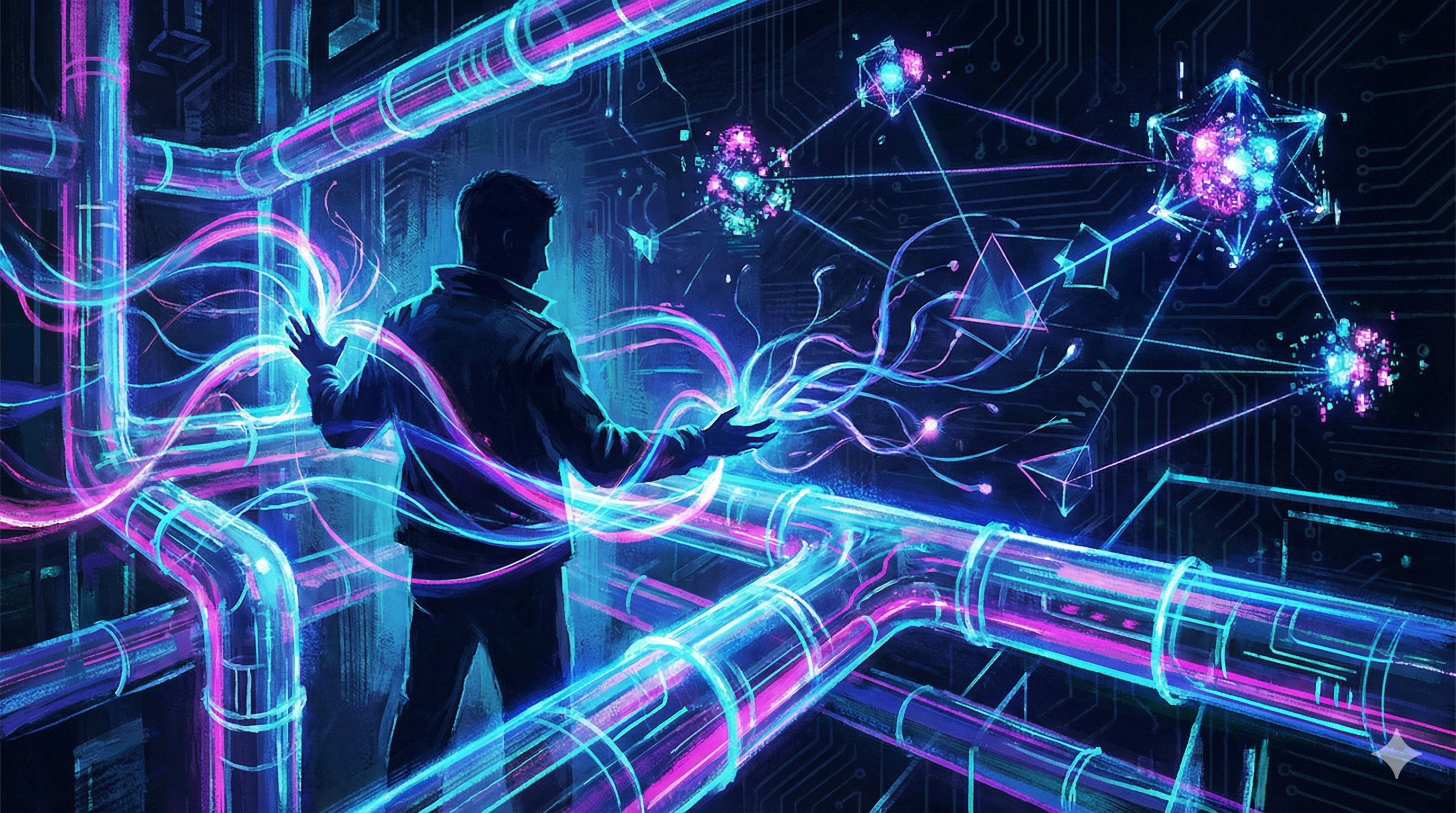
Something else is happening in the enterprise that deserves attention. The traditional model of building or buying applications for every business function is dissolving. In its place, AI agents and intelligent workflows are emerging — , Software Development Lifecycleot as fancy automation scripts, but as genuine decision-support systems that operate on massive amounts of data that no human team could process manually.
I spent years in organizations where middle management existed primarily to aggregate information from below and pass summarized decisions upward. Large frontier models are compressing that chain. Not by eliminating people, but by removing the friction of information synthesis. A security operations team that used to spend four hours triaging alerts before making a decision can now have an AI agent pre-analyze, correlate, and present a recommended action path within minutes. The human still decides. But the human decides faster and with better data.
Less management overhead. More focus on the core of the task at hand. This is not a slogan — it is what I am observing in real organizations right now.
The Psychological Weight of Constant Adaptation
What I do not see discussed enough is the psychological impact on the people living through this transformation. Every six months, the capabilities of advanced reasoning systems take another leap. Every six months, the baseline expectation for what a single engineer should be able to deliver shifts upward. This is exhausting. I know because I feel it myself, and I have been adapting to technology shifts for three and a half decades.
The pressure to continuously learn, to re-evaluate what you thought was a stable skill, to accept that your hard-won expertise in a specific area might be commoditized within a year — this is not trivial. Organizations that ignore this human dimension while chasing productivity gains from AI will find themselves with burned-out teams and high attrition. The technology is only as good as the people who guide it, and those people need support, time, and psychological safety to adapt.
So What Changes for People?
Everything and nothing. The fundamental truth of enterprise IT remains: humans build systems for other humans, and someone must be accountable when things go wrong. What changes is the layer between intention and execution. That layer is now filled with powerful reasoning systems that can draft, suggest, generate, and analyze at a scale we never had before.
For developers, the path forward is clear: become the person who understands why, not just how. For platform engineers, it means designing systems where AI agents and human operators work in well-defined boundaries. For security engineers, it means building Zero Trust not just for networks but for AI-generated outputs. And for IT leaders, it means accepting that the most important investment right now is not in technology. It is in the people who must learn to work alongside it.
After thirty-five years, I have learned that technology always promises more than it delivers in the short term, and delivers more than we imagined in the long term. The frontier models we see today are no exception. But the transition — the human transition — that is where the real work happens. And that work is happening right now, in every team, in every organization, whether we acknowledge it or not.
 ctoblog